
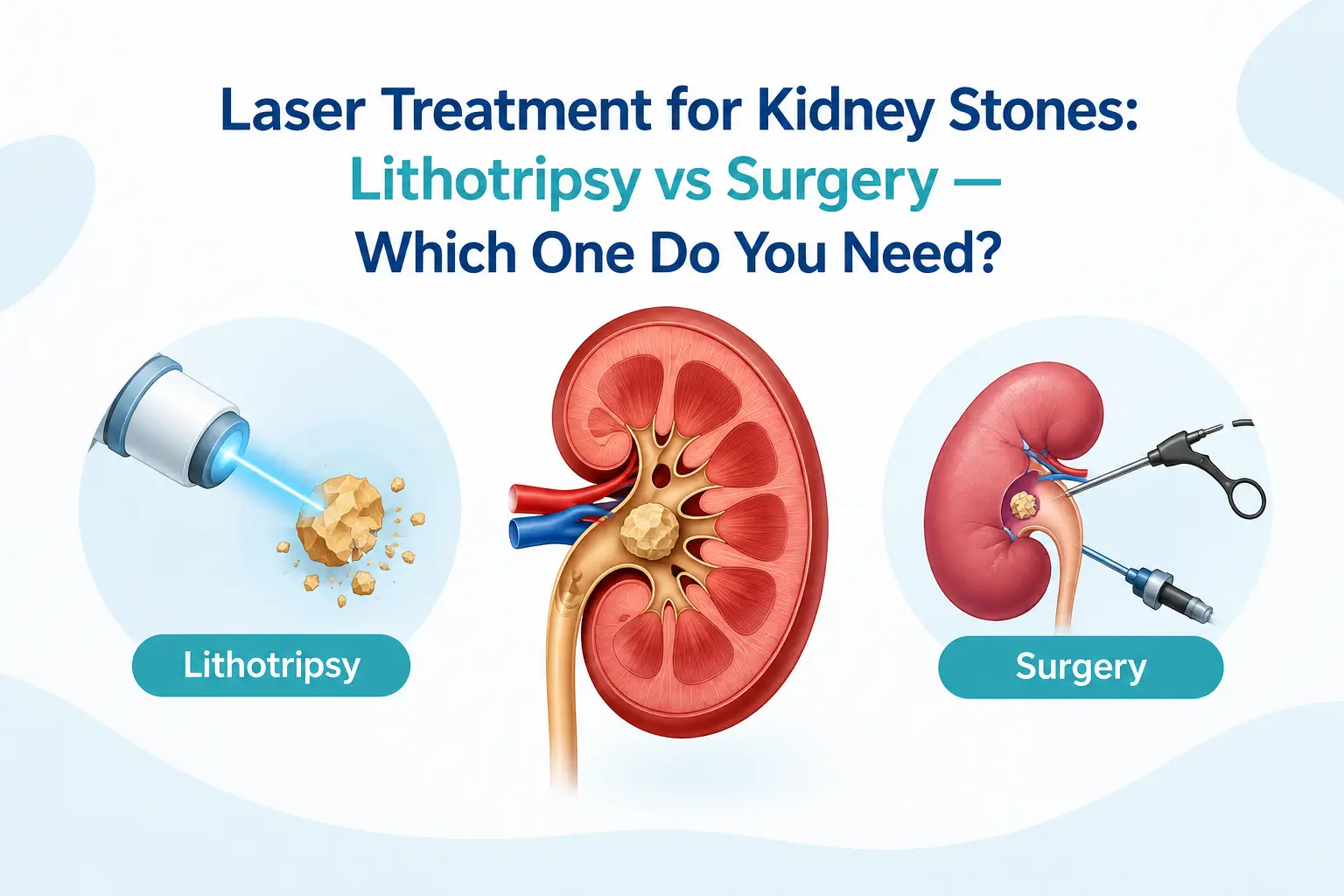
If you’ve been told you have a kidney stone, chances are your doctor has already mentioned a few treatment options — and the two words that come up most often are “lithotripsy” and “surgery.” Choosing between laser treatment for kidney stones, traditional surgery, and other minimally invasive options like lithotripsy for kidney stones can feel confusing, especially when you’re already dealing with pain. This guide breaks down lithotripsy vs surgery for kidney stones in plain language, explains how laser lithotripsy actually works, and helps you understand which treatment path might suit your case best — with insights from the specialists at Shanti Clinic & Nursing Home, Rohru.
Understanding Kidney Stones Before Choosing a Treatment
Kidney stones form when minerals and salts in urine crystallize and clump together inside the kidney. They can range from tiny grains that pass on their own to larger stones that block the urinary tract and cause severe pain, infection, or kidney damage if left untreated.
Not every stone needs a procedure. Doctors typically consider factors like stone size, location, composition, and whether it’s causing a blockage or infection before recommending a treatment. Small stones (under 4-5mm) often pass naturally with hydration and medication. Larger or stubborn stones usually require intervention — and this is where the debate between lithotripsy and surgery begins.
What Is Laser Treatment for Kidney Stones?
Laser treatment for kidney stones, medically known as laser lithotripsy, uses a thin laser fiber passed through a small scope (usually inserted through the urinary tract, with no external cuts) to break the stone into tiny fragments or dust. These fragments are then either removed directly or pass out naturally in the urine.
The laser used is typically a Holmium laser, known for its precision in fragmenting stones of almost any size, composition, or location — including stones that might be difficult to treat with older technologies. Because the procedure is minimally invasive, patients usually go home the same day or within 24 hours.
At Shanti Clinic, laser lithotripsy is combined with USG-guided lithotripsy techniques, meaning ultrasound imaging is used throughout the procedure to precisely locate the stone and guide the laser. This significantly reduces the risk of injury to surrounding tissue and improves accuracy.
What Is Lithotripsy for Kidney Stones?
The term “lithotripsy for kidney stones” is often used broadly, but it actually covers a few different techniques:
- Extracorporeal Shock Wave Lithotripsy (ESWL): Uses focused shock waves from outside the body to break the stone into smaller pieces, which then pass through urine. No incisions or scopes are involved.
- Laser Lithotripsy (Ureteroscopy with Laser): As described above, a scope with a laser fiber goes in through the urinary tract to directly target and break the stone.
- Percutaneous Nephrolithotomy (PCNL): For very large stones, a small incision is made in the back to remove the stone directly — this is more invasive than the other two but still far less invasive than open surgery.
Each method is chosen based on stone size, location, and the patient’s overall health. Laser lithotripsy is generally preferred for stones lodged in the ureter or kidney that are too large to pass but not large enough to require PCNL.
Lithotripsy vs Surgery for Kidney Stones: Key Differences
This is the question most patients want answered clearly. Here’s a straightforward comparison:
| Factor | Lithotripsy / Laser Treatment | Open Surgery |
|---|---|---|
| Incisions | None or minimal (natural body openings or tiny puncture) | Larger surgical incision |
| Anesthesia | Local or short general anesthesia | Full general anesthesia |
| Hospital stay | Same-day or 1 night | Several days |
| Recovery time | 2-5 days | 2-4 weeks |
| Pain after procedure | Mild to moderate | Higher, due to incision |
| Scarring | Minimal to none | Visible surgical scar |
| Suitable for | Most stones, including moderately large ones | Very large, complex, or complicated stones |
| Repeat treatment | Sometimes needed for very hard/large stones | Rarely needed |
In simple terms: lithotripsy vs surgery for kidney stones comes down to invasiveness versus complexity. Open surgery today is reserved almost exclusively for rare, complicated cases — anatomical abnormalities, extremely large staghorn stones, or when other methods have failed. For the vast majority of patients, laser lithotripsy or other minimally invasive techniques are the first choice because they offer comparable success rates with far less trauma to the body.
Benefits of Choosing Laser Lithotripsy Over Surgery
- Faster recovery – Most patients resume normal activities within a few days instead of weeks.
- Less pain – No large incision means significantly reduced post-procedure discomfort.
- Lower infection risk – Minimally invasive procedures carry a lower risk of surgical site infections.
- Shorter hospital stay – Many patients are discharged the same day.
- Precision – With USG guidance, doctors can target the stone accurately without damaging surrounding tissue.
- Suitable for a wide range of stone sizes – From moderate to fairly large stones, laser lithotripsy can often be used as an alternative to surgery.
Who Should Consider Laser Treatment?
Laser lithotripsy is generally a good option for patients who:
- Have a stone that hasn’t passed naturally after a few weeks
- Experience recurring pain, blood in urine, or signs of infection
- Have a stone located in the ureter or kidney that is accessible via scope
- Want a quicker recovery and minimal downtime
- Prefer to avoid a large surgical incision
That said, the right treatment always depends on an individual evaluation — stone size, location, kidney anatomy, and overall health all play a role. This is why a proper diagnosis, usually through ultrasound or CT imaging, is the first step before deciding between laser treatment for kidney stones, lithotripsy, or surgery.
What to Expect During Recovery
After laser lithotripsy, most patients experience mild discomfort for a day or two, which is manageable with prescribed medication. A temporary stent may be placed in the ureter to help with drainage and healing — this is usually removed within one to two weeks in a quick follow-up visit. Doctors typically recommend:
- Drinking plenty of water to flush out remaining stone fragments
- Avoiding heavy lifting or strenuous activity for a few days
- Attending follow-up appointments to confirm the stone is fully cleared
- Watching for any signs of fever, severe pain, or heavy bleeding and reporting them immediately
Why Choose Shanti Clinic & Nursing Home, Rohru?
At Shanti Clinic & Nursing Home, patients across Rohru and Himachal Pradesh trust our team for advanced, USG-guided laser lithotripsy performed with precision and compassionate care. Led by Dr. Roohail Sharma, our team combines modern laser technology with a patient-first approach, ensuring safe procedures and faster recovery.
If you’re still weighing your options, our detailed guide on kidney stone treatment cost and our article on early kidney stone symptoms can help you understand the full picture before your consultation. You can also read more about our approach if you’re searching for a kidney stone doctor near you.
For general reference on kidney stone management guidelines, you can also read this overview from the National Kidney Foundation.
Frequently Asked Questions (FAQ)
1. Is laser treatment for kidney stones painful?
Most patients experience only mild discomfort during recovery, which is far less than the pain associated with open surgery. Anesthesia is used during the procedure itself, so there’s no pain at that time.
2. How long does laser lithotripsy take?
The procedure typically takes 30 minutes to an hour, depending on the size and location of the stone.
3. Is lithotripsy better than surgery for kidney stones?
For most patients, yes — lithotripsy is less invasive, requires shorter recovery, and carries fewer risks compared to open surgery. However, very large or complex stones may still require surgical intervention.
4. Will I need multiple sessions of lithotripsy?
Some larger or harder stones may need more than one session, especially with shock wave lithotripsy. Laser lithotripsy usually clears stones in a single session.
5. How soon can I return to work after laser treatment?
Most patients return to normal daily activities within 3-5 days, though this can vary based on individual recovery.
6. Does USG-guided lithotripsy reduce risks?
Yes. Ultrasound guidance allows doctors to precisely locate the stone throughout the procedure, reducing the risk of damaging nearby tissue and improving overall accuracy.
7. Can kidney stones come back after laser treatment?
Yes, stones can recur if underlying causes like diet, hydration habits, or metabolic conditions aren’t addressed. Your doctor may recommend follow-up tests and lifestyle changes to reduce recurrence risk.
Conclusion
Choosing between laser treatment for kidney stones, other forms of lithotripsy for kidney stones, and traditional surgery doesn’t have to be overwhelming. For the majority of patients, minimally invasive options like laser lithotripsy offer a safer, faster, and less painful path to relief compared to open surgery, which is now reserved mainly for complex or unusually large stones. The right decision comes down to your specific stone size, location, and overall health — best assessed through a proper consultation and imaging.
If you’re dealing with kidney stone pain and want expert guidance on lithotripsy vs surgery for kidney stones, the team at Shanti Clinic & Nursing Home, Rohru is here to help. Book a consultation today and take the first step toward safe, effective, and lasting relief.